Table of Contents
Top 10 SEO Mistakes You Must Avoid to Boost Your Google Rankings
Many websites fail to achieve high rankings on Google, despite their significant efforts and investment in their businesses. This ranking is due to small yet critical mistakes, such as on-page SEO mistakes that hinder overall SEO performance. From keyword usage to some technical issues, these errors can prevent your website from being indexed or recognized on popular search engines.
The goal of this blog is to uncover the 10 top SEO problems and how to fix them. By addressing these mistakes and providing reasonable solutions to these problems, businesses can enhance their website’s visibility and ultimately drive more traffic.
Mistake #1
Writing For Search Engines- Not For People
Putting search engine optimization ahead of user experience is one of the most frequent SEO errors, which results in the website not ranking on Google. This frequently appears as keyword stuffing, when keywords are overly spammed in an attempt to influence rankings. Even if the goal could be to appease algorithms, this technique might result in strange, uncomfortable words that irritate readers and lower the content’s overall quality. In addition to decreasing user engagement, this strategy may result in search engine penalties, which would further hurt your rankings. Fix: One of the first steps to avoid this SEO mistake, to write organically while keeping the user’s purpose in mind to engage your readers. Make sure your material flows naturally and stays interesting by using keywords sparingly and contextually. In addition to increasing user experience, this helps if your website not ranking on Google like search engines.Mistake #2
Ignoring the Technical Foundation
Success in SEO requires a strong technological base. One of the main reasons for your website not ranking on Google if it doesn’t sound technical. Here are some common technical foundation mistakes:Your Site Isn’t Being Indexed
Important pages may be blocked by a robots.txt file or a missing sitemap if your website isn’t being indexed. Search engines cannot find your information if it is not properly indexed. Fix: To upload a sitemap and identify crawl problems, use Google Search Console. Make certain that search engines can reach key pages; for this, you can also take help from America SEO Agency to know tips and tricks to enhance your overall engagement.Mobile Unfriendliness
A bad mobile experience is one of the top SEO problems, and how to fix themis required, as nowadays more and more users are browsing via their mobile devices. If not paid attention to, it might result in major ranking reductions. Fix: Use Google’s Mobile-Friendly assessmenttool to assess your website, remove horizontal scrolling, and put in a design that is responsive, that adapts to different screen sizes.Slow Page Load Times
Slow page loading is a very crucial mistake, which hinders audience reach and results in your website not ranking on Google. No one is going to stay on your website if it hangs or takes time to load. Because people are less inclined to wait for a website to load, slow loading speeds result in higher bounce rates. Fix: To improve loading speeds, reduce the size of pictures, turn on caching, and get rid of bulky scripts. Certain problems can be found with the use of tools such as Google PageSpeed Insights.Mistake #3
Letting Your On-Page SEO Slip
For both consumers and search engines to comprehend the relevance of your content, on-page SEO is essential. Even small mistakes can result in big on-page SEO mistakes, if not catered to properly by the businesses.Skipping Title Tags & Meta Description
Your pages are given context by title tags and meta descriptions. Ignoring them might result in lost click-through and ranking possibilities. Fix: In order to resolve these on-page SEO mistakes and to increase exposure in search results, provide each page a distinct, understandable, and keyword-optimized title and description.Improper Use of Heading Tags
A poorly organized hierarchy of headers is also common on-page SEO mistakes, which might make it difficult for users and search engines to understand how your information is organized. Fix: For titles, use H1 tags; for key parts, use H2 tags; and for subpoints, use H3 tags. This structure enhances SEO and aids viewers in navigating your material.Lack of Internal Linking
Search engines have a difficult time finding and indexing your material if you don’t have internal links. This mistake further leads to more on-page SEO mistakes. Fix: Carefully connect popular pages to fresh or significant ones. This improves user navigation in addition to SEO.| On-page SEO Do’s | On-page SEO Don’ts |
| Use a unique and keyword-optimized title tag | Use duplicated title tags or miss it |
| Write naturally | Stuffed content |
| Use proper headings (h1,h2,h3) | Overuse H1s or skip it |
| Add clear meta descriptions | Leave meta descriptions blank or duplicated |
| Keep URLs short and keyword-rich | Using lengthy URLs |
| Ensure content is mobile-friendly | Ignoring mobile responsiveness |
| Use schema markup (when required) | Ignore structured-data opportunities |
| Include internal links when required | Leave pages without internal linking |
Mistake #4
Treating Content like a One-time Task
Treating content production as a one-and-done task is one of the top SEO problems, and how to fix them is mandatory to know. Posts are frequently forgotten after they are published, which causes material to eventually become outdated or obsolete. This carelessness can negatively affect user engagement and the authority of your website. Content that was previously useful could no longer be relevant to your audience as facts and trends change. Users may doubt your authenticity if they discover out-of-date content since they want accurate, up-to-date information. Fix: Update older postings often to provide multimedia, depth, and outbound connections to reliable sources. Your material remains current and pertinent as a result.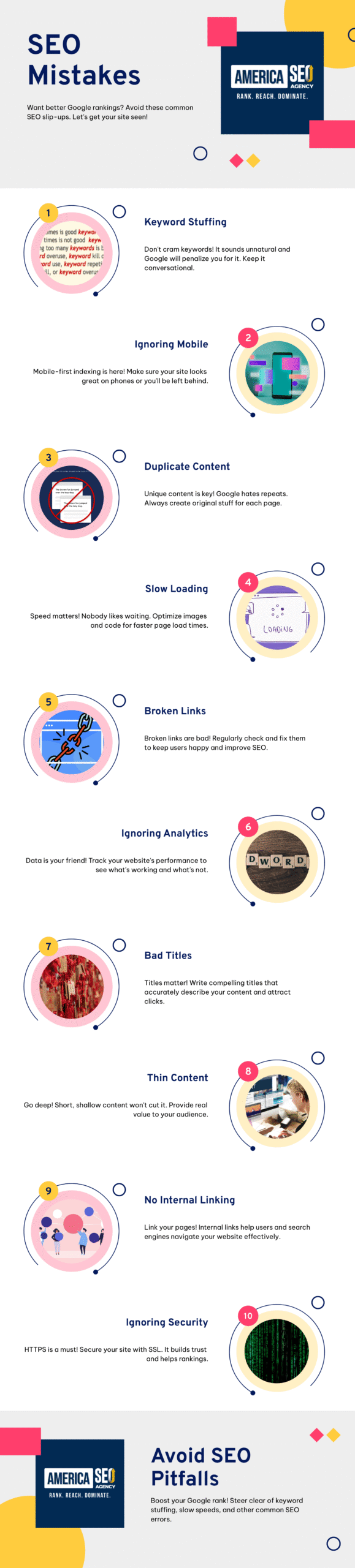
Mistake #5
Overlooking User Experience Signals
Ignoring the user experience results in poor time-on-site metrics and high bounce rates, which tell Google that your website might not be worth visiting. Users are more prone to depart soon, expressing discontent, when they come across busy layouts, illegible typefaces, or invasive adverts. Fix: Make sure your fonts are readable and streamline your site’s layout to improve user experience. Use as few distracting advertisements as possible, or use an assistance service such as USA Cheap SEO Service, which can provide you with options for easy layouts and optimize your website for better engagement. A simple, easy-to-use design improves your SEO performance by encouraging consumers to explore your content and stay on your site longer.Mistake #6
Not Measuring What Matters
You may be unaware of your SEO performance if you neglect to monitor crucial data. Without adequate tracking, you may not be aware of important problems that are influencing your rankings. Moreover, ignoring user conduct can also result in your website not ranking on Google. Fix: Use Google Search Console and set up Google Analytics 4 (GA4) to track keyword insights and crawl issues. Making well-informed decisions needs this data. To increase engagement, try headlines and calls-to-action using A/B testing. Improve the visual structure of your pages to better direct users. For this purpose, you can also hire an affordable SEO Serviceto enhance the visual appearance of your website.Mistake #7
Failing to Optimize For Featured Snippets
You may lose out on important search engine visibility if you don’t optimize for highlighted snippets. Failure to provide clear answers to consumers’ queries leads in the loss of featured snippets, which are valuable real estate at the very top of results pages for search engines. Users anticipate succinct responses when they search for specific inquiries. If your material falls short of their expectations, they can look to rivals who do. Fix: Use Q&A forms, bullet lists, and succinct summaries to organize your information and increase the likelihood that it will be published. In addition to increasing clarity, this is consistent with how search engines retrieve information for snippets.Mistake #8
Treating Links As an Option
Treating backlinks as optional is one of the most crucial and top SEO problems, and how to fix them is necessarily important, otherwise it may seriously damage your site’s authority, as they are still a vital ranking component in SEO. Your website may struggle to establish credibility and trust, which are essential for ranking well, if you don’t have a strong linking strategy.| External Backlinks | Internal Links |
| Demonstrate the authority and relevancy of your content | Aid search engines in crawling your website. |
Mistake #9
Outdated SEO Tactics
Many website owners continue to use antiquated SEO strategies that might hurt results, such as meta keywords and excessively optimized anchor text. Once-effective tactics may now result in penalties or ineffectual outcomes due to changes in search engine algorithms. Fix: Following the most recent SEO best practices is crucial to being competitive. To keep up with developments in the field, follow respectable SEO sites like Moz and Search Engine Journal.Mistake #10
Assuming SEO Is One & Done
It’s a frequent misperception that SEO is a one-time activity that doesn’t need to be done again. In actuality, SEO is a continuous process that necessitates frequent adjustment to shifting market dynamics and algorithmic changes. Over time, stagnation and falling rankings may result from neglecting to review your SEO approach. Fix: Perform routine site audits, update material on a regular basis, and monitor performance indicators to counteract this. You can stay competitive in search results and make sure that consumers continue to find your site helpful by consistently refining your approach.Conclusion:
In conclusion, adverse SEO errors can have a significant effect on the rankings of your website. In this blog, we have discussed the top SEO problems and how to fix them, so by following the tactics, you may change the fate of your website. You may increase the visibility of your website and draw in more visitors by making the required changes and keeping up with industry best practices. In the end, proactive SEO guarantees that your website stays competitive in a constantly changing digital environment.
Ryan F.